Skip to content
Artwork for Crisis in Perception
Crisis in Perception · Tuesday · 17 min

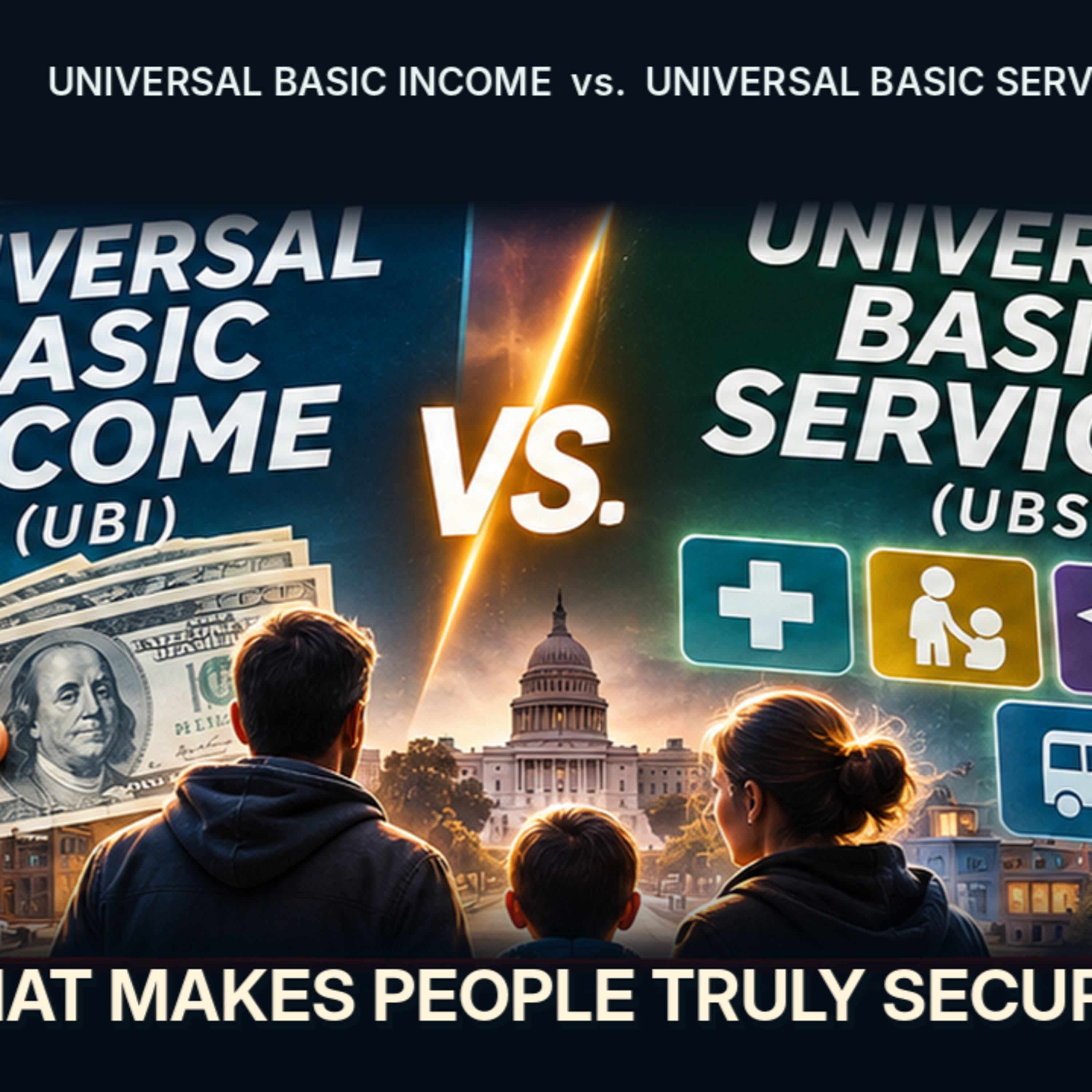
Universal Basic Income vs. Universal Basic Services — What Makes People Truly Secure? | CIP Debate

Would an unconditional monthly income provide greater freedom and economic security—or would guaranteed access to housing, healthcare, childcare, transportation, and other essential services do more to protect people's well-being? This episode presents AI-narrated educational analysis based on published sources. The voices are synthetic and do not represent real conversations, interviews with the authors, or human experts. AI-assisted tools support research synthesis, production, and narration. Source selection, editorial framing, and final editorial decisions are guided by human judgment as part of the Crisis in Perception project. Welcome to Crisis in Perception, where we examine the systems shaping our world. Economic security is often understood as having enough money to meet life's expenses. Yet income alone does not determine whether people can afford housing, obtain medical care, find childcare, or access the resources necessary to participate in society. This Crisis in Perception Debate compares two approaches to economic security: Universal Basic Income (UBI) and Universal Basic Services (UBS). UBI emphasizes unconditional cash payments, individual choice, and freedom from income insecurity. UBS focuses on guaranteeing access to essential resources through collectively funded services. Drawing on economic research, policy analysis, and real-world experiments, the investigation examines the tradeoffs between these models. The discussion explores Finland's basic-income experiment, unconditional cash payments in the United States, Quebec's subsidized childcare program, and research into universal school meals. It also examines the economic mechanisms beneath these policies: work incentives, housing supply, public infrastructure, taxation, service quality, and the distribution of household resources. Can cash payments provide meaningful freedom when essential services are unavailable? Can public provision guarantee security without introducing excessive bureaucracy or restricting individual choice? And could combining different approaches address problems that neither model resolves independently? The deeper question concerns how economic systems translate income, resources, and public investment into actual opportunities. Rather than assuming that one policy provides a universal solution, this debate investigates what the evidence reveals, where uncertainty remains, and how societies might measure genuine economic security. 📺 Watch on YouTube: https://youtu.be/VmmbEuISpBc ❤️ Support / Episode Post on Patreon: https://www.patreon.com/CrisisinPerception/posts/universal-basic-174909237?utm_medium=clipboard_copy&utm_source=copyLink&utm_campaign=postshare_creator&utm_content=join_link If these ideas resonate, consider reading the work yourself or borrowing it from your local library. Supporting authors and libraries helps keep critical inquiry accessible. If you value systems-level analysis like this, please follow, rate, and share the project.

0:00-17:45

transcript

No transcript — this publisher did not publish one.

show notes

Would an unconditional monthly income provide greater freedom and economic security—or would guaranteed access to housing, healthcare, childcare, transportation, and other essential services do more to protect people's well-being?

This episode presents AI-narrated educational analysis based on published sources. The voices are synthetic and do not represent real conversations, interviews with the authors, or human experts.

AI-assisted tools support research synthesis, production, and narration. Source selection, editorial framing, and final editorial decisions are guided by human judgment as part of the Crisis in Perception project.

Welcome to Crisis in Perception, where we examine the systems shaping our world.

Economic security is often understood as having enough money to meet life's expenses. Yet income alone does not determine whether people can afford housing, obtain medical care, find childcare, or access the resources necessary to participate in society.

This Crisis in Perception Debate compares two approaches to economic security: Universal Basic Income (UBI) and Universal Basic Services (UBS).

UBI emphasizes unconditional cash payments, individual choice, and freedom from income insecurity. UBS focuses on guaranteeing access to essential resources through collectively funded services.

Drawing on economic research, policy analysis, and real-world experiments, the investigation examines the tradeoffs between these models.

The discussion explores Finland's basic-income experiment, unconditional cash payments in the United States, Quebec's subsidized childcare program, and research into universal school meals.

It also examines the economic mechanisms beneath these policies: work incentives, housing supply, public infrastructure, taxation, service quality, and the distribution of household resources.

Can cash payments provide meaningful freedom when essential services are unavailable? Can public provision guarantee security without introducing excessive bureaucracy or restricting individual choice? And could combining different approaches address problems that neither model resolves independently?

The deeper question concerns how economic systems translate income, resources, and public investment into actual opportunities.

Rather than assuming that one policy provides a universal solution, this debate investigates what the evidence reveals, where uncertainty remains, and how societies might measure genuine economic security.

📺 Watch on YouTube:
https://youtu.be/VmmbEuISpBc


❤️ Support / Episode Post on Patreon:
https://www.patreon.com/CrisisinPerception/posts/universal-basic-174909237?utm_medium=clipboard_copy&utm_source=copyLink&utm_campaign=postshare_creator&utm_content=join_link


If these ideas resonate, consider reading the work yourself or borrowing it from your local library. Supporting authors and libraries helps keep critical inquiry accessible.

If you value systems-level analysis like this, please follow, rate, and share the project.