Skip to content
Artwork for Creative Figures
ArtsDesignBusinessEntrepreneurship

Creative Figures

Creative Figures

Creative Figures is a long-form interview show about how creative people actually live and work. One guest per episode — artists, designers, illustrators, writers, filmmakers, makers of every kind — and no hurry: the practice behind the portfolio, the decisions behind the career, the parts that never make the highlight reel. Between conversations, occasional solo episodes on craft and creative independence.

Filmed in full — watch at creativefigures.fm, or listen wherever you get your shows.

Hosted by Alen Kapetanovic.
Formerly CAPTN OffScript.

Play
  • 36 episodes
  • weekly
  • Avg 34 min
  • English
Counted on this page — what you have heard stays on this device, so it is not something the list can be paged by.
  • S3 · E111
    Yesterday · 6 min· Video

    Bernardo Henning on the design scene in Argentina and South America

    PUBLICIDAD · SPONSORED BY BLACKWING Pencils made with Japanese graphite and California cedar for nearly 100 years. Get 10% off with code CREATIVE10 at https://creativefigures.fm/go/blackwing Illustrator Bernardo Henning (Hola Maybe) on Buenos Aires as a creative city, and why South America is "that gem yet to be discovered". "It's a disadvantage and also an advantage, because South America is like that gem yet to be discovered by the artistic or design world." In this bonus to his main episode, Bernardo explains why some cities have more marketing behind their creative scenes, and why he sees Buenos Aires as a creative city, from illustration and graphic design to advertising and cinema. He talks about the disadvantage of being on the other side of the world, and how growing up in places like Brazil or Mexico changes the way you use colour, so that you're not afraid of it. Timestamps 00:00 Design beyond New York and London 01:39 Buenos Aires, a creative city 02:16 The other side of the world 02:50 A gem yet to be discovered 03:54 Not afraid of colour If you liked this episode, listen to the full conversation with Bernardo Henning on Creative Figures. Bernardo Henning Instagram: https://www.instagram.com/holamaybe/ Behance: https://www.behance.net/Maybe LinkedIn: https://www.linkedin.com/in/bosquestudio/ Hola Bosque (studio): https://www.instagram.com/holabosque/ Creative Figures 🔗 https://creativefigures.fm 📹 https://www.youtube.com/@CreativeFiguresFM Instagram: https://www.instagram.com/creativefigures.fm/ Hosted by Alen Kapetanovic. © Alen Kapetanovic. Madrid, Spain. All rights reserved. This work may not be used to train AI or for automated data mining purposes, including under Article 4(3) of Directive (EU) 2019/790.

  • S3 · E110
    Wednesday · 47 min· Video

    Kelsey Slay on TikTok, Adobe and why creativity is profoundly human

    PUBLICIDAD · SPONSORED BY CREATIVE MARKET AND BLACKWING Creative Market: fonts, graphics and templates from independent creators. Get 20% off with code CREATIVEFIGURES at https://creativefigures.fm/go/creative-market Blackwing: pencils made with Japanese graphite and California cedar for nearly 100 years. Get 10% off with code CREATIVE10 at https://creativefigures.fm/go/blackwing Designer Kelsey Slay on going from TikTok to Adobe, never watering herself down, and why creativity is profoundly human. "I think creativity is so profoundly human. It's just in us to want to make things." Kelsey started a graphic design TikTok in 2022, and six months later a director at Adobe messaged her about a job. She thought it was a scam. She talks about preparing for months for a live demo at Adobe MAX in front of 10,000 people, the relief and the crash afterwards, and growing up different in a small town in Georgia, with parents who told her to go to art school. She explains why she will never water herself down, how she deals with hate comments, why she thinks a sea of sameness creates a hunger for things that look different, and why she took a break from design to only cross-stitch. Timestamps 00:00 Opening 01:01 Sponsors 01:45 Ten thousand people at Adobe MAX 04:04 Relief, a high and a crash 06:24 From TikTok to Adobe 08:09 "I thought I was getting scammed" 09:13 Growing up different 11:03 Never watering herself down 12:13 Hate comments 13:06 A bridge between the community and Adobe 17:35 Art school and supportive parents 19:52 A big Halloween fan 22:36 Advice for young designers in the age of AI 25:03 What she's happy to let AI do 25:50 Overhype and a sea of sameness 28:46 "The math isn't mathing" 36:09 The answer is in the middle 38:44 Going more analog 41:03 A break from design to cross-stitch 42:29 Creativity is profoundly human 43:29 AI slop and cats cooking dinner 46:11 Advice to her younger self If you liked this episode, listen to Rebeka Arce on Creative Figures. Kelsey Slay Instagram: https://www.instagram.com/kelseyslaydesign/ TikTok: https://www.tiktok.com/@kelseyslaydesign LinkedIn: https://www.linkedin.com/in/kelsey-slay/ Creative Figures Website: https://creativefigures.fm YouTube: https://www.youtube.com/@CreativeFiguresFM Instagram: https://www.instagram.com/creativefigures.fm/ Hosted by Alen Kapetanovic. © Alen Kapetanovic. Madrid, Spain. All rights reserved. This work may not be used to train AI or for automated data mining purposes, including under Article 4(3) of Directive (EU) 2019/790.

  • S3 · E109
    November 20 · 7 min· Video

    Rebeka Arce on music, records and a morning ritual

    PUBLICIDAD · SPONSORED BY BLACKWING Pencils made with Japanese graphite and California cedar for nearly 100 years. Get 10% off with code CREATIVE10 at https://creativefigures.fm/go/blackwing Designer and creative director Rebeka Arce on the music that came before design, and the record that starts every morning. "I just feel that design wasn't there when I was a child, but music was always there." In this bonus to her main episode, Rebeka talks about growing up as the youngest, taking the CDs her older brothers brought home, and her mother playing the same records over and over again. She explains why music led her to study motion design, and why she works with motion and sound designers rather than making the motion herself. She also tells the story of the New York record store owner who asked if she was a DJ, and who encouraged her to share her collection of ambient records. Today she does listening sessions with friends and for radio shows. Timestamps 00:00 Opening 01:13 Records on the shelf 01:59 Music in her work 03:14 Before design, there was music 04:25 Finding her people through music 04:46 Buying records again 05:41 "Are you a DJ?" 06:17 Sharing the collection If you liked this episode, listen to the full conversation with Rebeka Arce on Creative Figures. Rebeka Arce Website: https://byarce.com/ Instagram: https://www.instagram.com/rebekaarce LinkedIn: https://www.linkedin.com/in/rebekaarce/ Behance: https://www.behance.net/rebekaarce Creative Figures Website: https://creativefigures.fm YouTube: https://www.youtube.com/@CreativeFiguresFM Instagram: https://www.instagram.com/creativefigures.fm/ Hosted by Alen Kapetanovic. © Alen Kapetanovic. Madrid, Spain. All rights reserved. This work may not be used to train AI or for automated data mining purposes, including under Article 4(3) of Directive (EU) 2019/790.

  • S3 · E108
    November 19 · 44 min· Video

    Rubio & del Amo on a lost space agency identity, euro banknotes and designing from Murcia

    PUBLICIDAD · SPONSORED BY BLACKWING Pencils made with Japanese graphite and California cedar for nearly 100 years. Get 10% off with code CREATIVE10 at https://creativefigures.fm/go/blackwing Julián and Guillermo of the Murcia studio Rubio & del Amo on the Spanish Space Agency identity that was never used, the new euro banknotes and designing from outside the big cities. "It's the most important project we have done." Julián and Guillermo started Rubio & del Amo 14 years ago in Murcia, where they work mainly on brand projects, along with packaging, campaigns, websites and editorial. They talk about deciding not to open an office in Madrid, coming to design from advertising and public relations, and their rule that they don't work for free. With Cruz Más Cruz, the studio of José María Cruz Novillo, they won the competition for the identity of the Spanish Space Agency. Months later, they were told another identity would be presented the following week, and they still don't have a clear explanation. They also talk about their proposals for the European Central Bank's open call for the new euro banknotes, why a banknote is closer to branding or packaging than to a poster, why a supermarket is a good thermometer of a country's design, and the advice they give young designers. The conversation is partly in English and partly in Spanish. Timestamps 00:00 Opening 02:29 Meet Rubio & del Amo 04:30 Carlos Alcaraz and life in Murcia 06:09 Problem or opportunity? 07:56 Advertising, then design 09:45 An office in Madrid? 11:52 Learning design on the street 14:36 Before the studio 17:45 The Spanish Space Agency 19:45 "We don't work for free" 20:20 Teaming up with Cruz Más Cruz 23:41 The brand that was never used 27:23 The new euro banknotes 29:17 Ten winning proposals 32:18 "The most important project we have done" 33:56 Why a banknote is different 35:31 A two-line brief 37:41 The state of design in Spain 38:22 The supermarket test 39:25 A double complex 42:10 An internship before a master's 45:36 Don't lose your way of looking 46:42 "You have a style" Rubio & del Amo Website: https://rubioydelamo.com/ Instagram: https://www.instagram.com/rubioydelamo Behance: https://www.behance.net/rubioydelamo Creative Figures Website: https://creativefigures.fm YouTube: https://www.youtube.com/@CreativeFiguresFM Instagram: https://www.instagram.com/creativefigures.fm/ Hosted by Alen Kapetanovic. © Alen Kapetanovic. Madrid, Spain. All rights reserved. This work may not be used to train AI or for automated data mining purposes, including under Article 4(3) of Directive (EU) 2019/790.

  • S3 · E107
    November 13 · 5 min· Video

    Nick Liefhebber on pricing and licensing your work

    PUBLICIDAD · SPONSORED BY BLACKWING Pencils made with Japanese graphite and California cedar for nearly 100 years. Get 10% off with code CREATIVE10 at https://creativefigures.fm/go/blackwing Illustrator Nick Liefhebber on pricing your work when you're starting out, and how licensing can protect it. "My advice for young illustrators or artists would be try to think in a creative way: learn about licensing, how to protect your work, or maybe ask for a certain amount now and a certain amount later." In this bonus to his main episode, Nick explains that many projects are hard to price when you're starting out, and that it's also about connecting with people and brands. He shares how a client with a small budget can use the work for one year, with more compensation to discuss if their business grows, and what he learned about licensing from working with an agency and from the structured design industry in the Netherlands. He also talks about why proposing licensing feels scary at first, and why it isn't for him anymore. Timestamps 00:00 Projects that are hard to price 01:01 Some now, some later 01:25 Where he learned about licensing 04:22 Why it feels scary at first 04:53 Is it still scary? If you liked this episode, listen to the full conversation with Nick Liefhebber on Creative Figures. Nick Liefhebber Website: http://www.liefhebber.biz/ Shop: https://liefhebber.bigcartel.com/ Instagram: https://www.instagram.com/nick_liefhebber/ Behance: https://www.behance.net/Liefhebber/ Creative Figures Website: https://creativefigures.fm YouTube: https://www.youtube.com/@CreativeFiguresFM Instagram: https://www.instagram.com/creativefigures.fm/ Hosted by Alen Kapetanovic. © Alen Kapetanovic. Madrid, Spain. All rights reserved. This work may not be used to train AI or for automated data mining purposes, including under Article 4(3) of Directive (EU) 2019/790.

  • S3 · E106
    November 10 · 49 min· Video

    Bernardo Henning on graffiti, movement and organizing chaos

    PUBLICIDAD · SPONSORED BY BLACKWING · Pencils made with Japanese graphite and California cedar for nearly 100 years. Get 10% off with code CREATIVE10 at https://creativefigures.fm/go/blackwing Illustrator Bernardo Henning (Hola Maybe) on graffiti, finding his own style, drawing movement onto athletes and organizing chaos. "When it comes to your own style, it's you versus you. It's you inside your head, just trying to not follow the trends, but follow your guts." Bernardo Henning is an illustrator and graphic designer based in Buenos Aires. He saw graffiti for the first time in La Plata, the city drawn with a ruler, and started painting on the streets and working at DOMA in his first year of university. Today he runs the branding studio Hola Bosque with friends and works solo as a commercial artist. He talks about why finding your own style is "you versus you", the canvas at the entrance of his first solo exhibition saying the worst thing that happened to him as an artist was being a graphic designer, and why he now sees the combination of both as the key to his work. He also explains how Procreate changed his process, how he draws energy onto photos of athletes, what he thinks about AI, and the advice he would give his kids. Timestamps 00:00 Opening 01:45 La Plata, the diagonal city 03:29 Where Hola Maybe comes from 05:48 Graffiti and writing fast 06:42 A studio and a solo career 08:21 You versus you 10:30 Imposter syndrome and commercial art 12:32 The right place at the right time 14:55 Discovering graphic design 16:48 "The worst thing that happened to me as an artist" 21:44 The canvas he would hang today 22:42 Learning from his daughter 27:11 Procreate and a style that moves 30:25 Drawing energy onto athletes 32:58 Stars and newcomers 36:11 Messi, Julián Álvarez and football 39:37 Life outside of work 41:03 AI: "I don't love it, I don't hate it" 43:17 Brands asking for the process 45:22 One piece to keep 47:47 Advice for his kids Bernardo Henning Instagram: https://www.instagram.com/holamaybe/ Behance: https://www.behance.net/Maybe LinkedIn: https://www.linkedin.com/in/bosquestudio/ Hola Bosque (studio): https://www.instagram.com/holabosque/ Creative Figures https://creativefigures.fm YouTube: https://www.youtube.com/@CreativeFiguresFM Instagram: https://www.instagram.com/creativefigures.fm/ Hosted by Alen Kapetanovic. © Alen Kapetanovic. Madrid, Spain. All rights reserved. This work may not be used to train AI or for automated data mining purposes, including under Article 4(3) of Directive (EU) 2019/790.

  • S3 · E105
    October 27 · 50 min· Video

    Rebeka Arce on wonder, the aesthetics of fear and being unfinished

    PUBLICIDAD · SPONSORED BY BLACKWING Pencils made with Japanese graphite and California cedar for nearly 100 years. Get 10% off with code CREATIVE10 at https://creativefigures.fm/go/blackwing Rebeka Arce on growing up in a steel town, sharing doubt as a creative director at Collins, and the "aesthetics of fear" in design. "I feel like LLMs are built to please us, not to contradict us. And I think contradiction is a big part of a creative process." Rebeka Arce grew up in Barakaldo, near Bilbao, a town shaped by the steel industry. Her mother wanted her to become a doctor and her father suggested topography, so she studied that first, before committing to design. She went on to live and work in Berlin and Madrid, where she started her freelance practice, and moved to New York to join Collins as a creative director. She now works independently. She explains why she separates the creative act, the design practice and the design industry, why she doesn't want to call it AI, and how fear of being too different or not being enough is leading decisions in the industry. She also talks about cultivating curiosity outside the laptop, choosing to share her doubts with her team at Collins, and what her students taught her about being a learner. Timestamps 00:00 Opening 01:35 A life in constant flux 03:03 Growing up in a steel town 05:28 A doctor or a topographer 07:36 Choosing design 10:09 Working-class values and resilience 13:57 Berlin, Bilbao and Madrid 17:49 Moving to New York 19:35 Diversity and being unfinished 23:10 How the design world has changed 23:56 The creative act, the practice and the industry 26:22 Why she doesn't call it AI 27:52 The aesthetics of fear 31:42 Teaching and curiosity 34:04 Where ideas come from 35:08 Contradiction and working in a team 37:35 Showing doubt as a creative director 39:54 "The creative practice is a violent act" 42:00 A big team or working alone 44:20 Choosing her projects 46:32 Coming back to Spain 48:03 What she learned from her students Rebeka Arce Website: https://byarce.com/ Instagram: https://www.instagram.com/rebekaarce LinkedIn: https://www.linkedin.com/in/rebekaarce/ Behance: https://www.behance.net/rebekaarce Creative Figures Website: https://creativefigures.fm YouTube: https://www.youtube.com/@CreativeFiguresFM Instagram: https://www.instagram.com/creativefigures.fm/ Hosted by Alen Kapetanovic. © Alen Kapetanovic. Madrid, Spain. All rights reserved. This work may not be used to train AI or for automated data mining purposes, including under Article 4(3) of Directive (EU) 2019/790.

  • S3 · E104
    October 23 · 3 min· Video

    Erik Herrström on the Pinterest trap

    PUBLICIDAD · SPONSORED BY BLACKWING Pencils made with Japanese graphite and California cedar for nearly 100 years. Get 10% off with code CREATIVE10 at https://creativefigures.fm/go/blackwing Designer Erik Herrström on why starting a project on Pinterest leads every designer to the same work, and the research his studio uses instead. "If you start your project by going to those sites, you are gonna end up designing what all the other designers in the world are doing right now because it's fed to you by algorithms." In this bonus from his Creative Figures conversation, Erik answers what young designers should use instead of mood boards built on Pinterest, Savee, Are.na and other inspiration sites. Something can feel fresh on the morning you start, he explains, but most other designers are seeing the same thing at the same time. His studio starts with research instead: Reddit and YouTube to see how an audience talks and communicates, and sometimes Google Street View to understand a local area. That, he says, is often where the magic happens, and it makes more sense to clients than something that only looks shiny. Timestamps 00:00 Opening 00:13 What to use instead of mood boards 00:29 How algorithms make us design the same If you liked this episode, listen to the full conversation with Erik Herrström on Creative Figures. Erik Herrström STUDIO HERRSTRÖM: https://www.studioherrstrom.com/ The Echo: https://the-echo-book.com/ Instagram: https://www.instagram.com/herrstrom/ Studio Instagram: https://www.instagram.com/studioherrstrom/ LinkedIn: https://www.linkedin.com/in/erikherrstrom/ Studio LinkedIn: https://www.linkedin.com/company/studio-herrstrom/ Creative Figures Website https://creativefigures.fm YouTube: https://www.youtube.com/@CreativeFiguresFM Instagram: https://www.instagram.com/creativefigures.fm/ Hosted by Alen Kapetanovic. © Alen Kapetanovic. Madrid, Spain. All rights reserved. This work may not be used to train AI or for automated data mining purposes, including under Article 4(3) of Directive (EU) 2019/790.

  • S3 · E103
    October 16 · 3 min

    Murugiah on reinvention and following the fun

    PUBLICIDAD · SPONSORED BY BLACKWING Pencils made with Japanese graphite and California cedar for nearly 100 years. Get 10% off with code CREATIVE10 at https://creativefigures.fm/go/blackwing llustrator and artist MURUGIAH on whether artists should reinvent themselves, and why he follows the fun instead. "Don't let what you did last get in the way of what you want to do in the future." In this bonus from his Creative Figures conversation, MURUGIAH answers whether artists should reinvent themselves every few years, the way Madonna does. He describes how he moved from digital work to analogue painting through small adjustments, keeping his motifs and line style while changing the surface. He talks about a 3D animation projection project with a collaborator working in Unreal Engine, and why collaboration means letting go of how your work has looked before. And he explains why he lets his past digital work speak for itself while he focuses on getting good at painting. If you liked this episode, listen to the full conversation with Murugiah on Creative Figures. MURUGIAH Website: https://murugiah.com Instagram: https://www.instagram.com/_murugiah/ Creative Figures Website: https://creativefigures.fm YouTube https://www.youtube.com/@CreativeFiguresFM Instagram: https://www.instagram.com/creativefigures.fm/ Hosted by Alen Kapetanovic. © Alen Kapetanovic. Madrid, Spain. All rights reserved. This work may not be used to train AI or for automated data mining purposes, including under Article 4(3) of Directive (EU) 2019/790.

  • S3 · E102
    October 13 · 41 min· Video

    Nick Liefhebber on paper cuts, printmaking and working with limitations

    PUBLICIDAD · SPONSORED BY BLACKWING Pencils made with Japanese graphite and California cedar for nearly 100 years. Get 10% off with code CREATIVE10 at https://creativefigures.fm/go/blackwing Illustrator Nick Liefhebber on paper cuts, woodcut printmaking, going independent one day at a time, and why limitations shape his work. "When you just start making things you like, it doesn't feel like work." Nick Liefhebber is an illustrator, designer and printmaker based in the Netherlands. He started as a graphic designer, and his turning point came when he decided to make work he didn't have to explain, just for himself. He left his job gradually, from five days a week to four, then three, before going independent. He explains why almost all of his work starts with physical materials such as cut paper, how woodcut and linocut are pushing his colourful work towards black and white, and why he blocks time for personal work that later shapes his client work. He also talks about social media feeling more like work, why he compares the future of illustration to an artisanal bakery, and what he would tell his ten-year-old self: trust yourself. Timestamps If you liked this episode, listen to Murugiah on Creative Figures. Nick Liefhebber Website: http://www.liefhebber.biz/ Shop: https://liefhebber.bigcartel.com/ Instagram: https://www.instagram.com/nick_liefhebber/ Behance: https://www.behance.net/Liefhebber/ Creative Figures 🔗 https://creativefigures.fm YouTube https://www.youtube.com/@CreativeFiguresFM Instagram: https://www.instagram.com/creativefigures.fm/ Hosted by Alen Kapetanovic. © Alen Kapetanovic. Madrid, Spain. All rights reserved. This work may not be used to train AI or for automated data mining purposes, including under Article 4(3) of Directive (EU) 2019/790.
  • S3 · E101
    October 6 · 54 min· Video

    Erik Herrström on brands that move culture, David Bowie and working without mood boards

    PUBLICIDAD · SPONSORED BY BLACKWING Pencils made with Japanese graphite and California cedar for nearly 100 years. Get 10% off with code CREATIVE10 at https://creativefigures.fm/go/blackwing Designer Erik Herrström on his book The Echo, why his studio never shows clients a mood board, and designing identities for Whitney Houston and Elvis Presley. "We never show mood boards to our clients, ever." Erik Herrström grew up in a small village in the south of Sweden and built his first website at twelve. He interned at R/GA in New York on the redesign of Nike.com, later joined the team of a designer he had idolised as a teenager, and spent years at Spotify, where he worked on Spotify Wrapped. Six years ago he moved to Vienna, where he now runs STUDIO HERRSTRÖM. He talks about the David Bowie exhibition his team built in a SoHo subway station, creating identities with the estates of Whitney Houston and Elvis Presley, and why mood boards keep work measured against other people's references. He explains why he wrote The Echo, how beta readers changed its whole structure, and why he self-published it. He also shares his view on AI and brand design, and his advice for young designers: stay curious, avoid shortcuts, and ask to shadow someone experienced. Erik Herrström STUDIO HERRSTRÖM: https://www.studioherrstrom.com/ The Echo: https://the-echo-book.com/ Instagram: https://www.instagram.com/herrstrom/ Studio Instagram: https://www.instagram.com/studioherrstrom/ LinkedIn: https://www.linkedin.com/in/erikherrstrom/ Studio LinkedIn: https://www.linkedin.com/company/studio-herrstrom/ Creative Figures 🔗 https://creativefigures.fm YouTube: https://www.youtube.com/@CreativeFiguresFM Instagram: https://www.instagram.com/creativefigures.fm/ Hosted by Alen Kapetanovic. © Alen Kapetanovic. Madrid, Spain. All rights reserved. This work may not be used to train AI or for automated data mining purposes, including under Article 4(3) of Directive (EU) 2019/790.

  • S3 · E100
    October 1 · 47 min· Video

    Murugiah on persistence, identity and his first museum show

    PUBLICIDAD · SPONSORED BY BLACKWING Pencils made with Japanese graphite and California cedar for nearly 100 years. Get 10% off with code CREATIVE10 at https://creativefigures.fm/go/blackwing Illustrator and artist MURUGIAH on leaving architecture, finding his own style, and opening the Quentin Blake Centre for Illustration with his first solo museum show. "Everything you've done, it doesn't have to just end. It can be fuel for what you do next." MURUGIAH trained as an architect for seven years before turning to illustration. Born in Burton upon Trent and raised in South Wales with Sri Lankan heritage, he spent more than a decade searching for a style that felt his own. A mentor's advice during the pandemic led him to make work about his childhood search for identity, and a new piece every week built the visual language behind his commissions, posters, clothing collaborations and public sculpture. He talks about his debut solo exhibition, MURUGIAH: Ever Feel Like…, one of three shows that opened the Quentin Blake Centre for Illustration in 2026, and explains why he feels no guilt about leaving architecture. He also speaks about the slowdown in commercial illustration and how he works across public art, talks, workshops and his own products. For artists starting out, he recommends persistence, obsession with the subjects you love, and a simple two-column exercise for finding work no one else could make. MURUGIAH Website: https://murugiah.com Instagram: https://www.instagram.com/_murugiah/ Creative Figures 🔗 https://creativefigures.fm YouTube https://www.youtube.com/@CreativeFiguresFM Instagram: https://www.instagram.com/creativefigures.fm/ Hosted by Alen Kapetanovic. © Alen Kapetanovic. Madrid, Spain. All rights reserved. This work may not be used to train AI or for automated data mining purposes, including under Article 4(3) of Directive (EU) 2019/790.
  • September 23 · 4 min

    E99 - Second Take: Kieron Anthony Lewis, "A Book Inside Concrete"

    Kieron Anthony Lewis opens this one by saying he cannot do the project justice by describing it. That you almost have to see it. He is right, which is awkward for a podcast. So here it is: a 456-page hardback with gold foiling along the edges, sealed inside a case made of concrete, cast in the shape of Tafawa Balewa Square in Lagos. Around seven kilos all in. The book features 161 artists connected to that square, produced in connection with the Lagos Biennial and timed to Nigeria's 65th independence anniversary. The brief, as he first understood it, was that they were going to make a coffee table book. He designed it over roughly two years in London, with London printers. The concrete case was made by the team in Lagos. Which means the first time he saw the two together was when he arrived in Nigeria, almost nervous, thinking — can you imagine if it doesn't fit? This is Second Take, a short format on the show. One idea, one guest, lifted out of a longer conversation. You do not need to have heard the original. Full conversation with Kieron: https://creativefigures.fm/s02-e12-kieron-anthony-lewis-on-editorial-design-identity-and-finding-meaning-through-work/ Find Kieron here: https://kieronlewis.com/ Instagram: https://www.instagram.com/kieronanthonyl/ Find me here: https://creativefigures.fm Instagram: https://www.instagram.com/creativefigures.fm/ Video version includes footage courtesy of Lagos Biennial https://lagos-biennial.org/ and Kieron Anthony Lewis https://kieronlewis.com/

  • September 2 · 6 min· Video

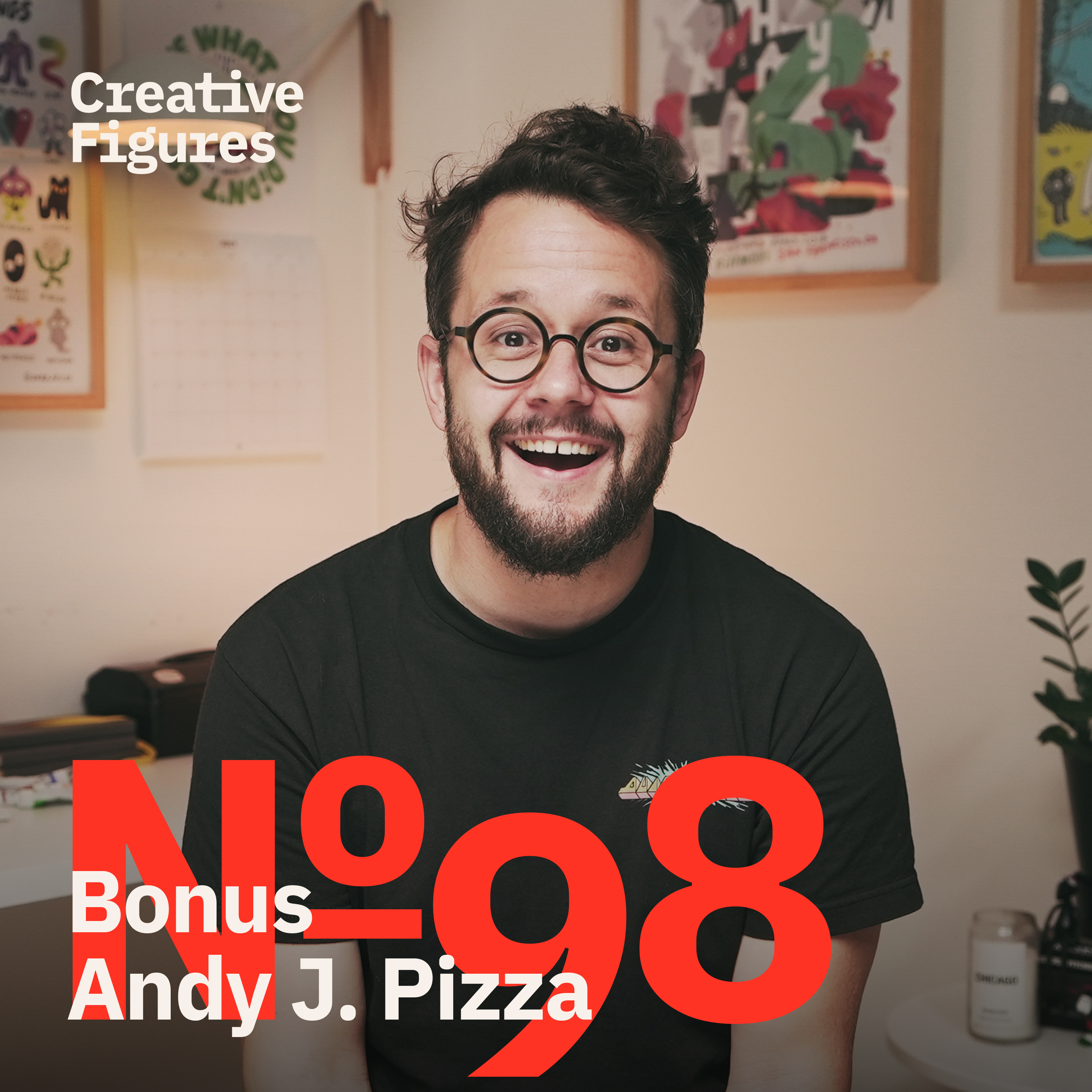
    E98 - Second Take: Andy J. Pizza, "Cultivate Yourself, Don't Overcome Yourself"

    I asked Andy how long it took him to start liking himself the way he is. He did not give me a number. He said it is something he has to constantly return to and refresh. This is Second Take, a short format on the show. One idea, one guest, lifted out of a longer conversation. You do not need to have heard the original. Around 25, Andy started to realise he probably has ADHD. His first reaction was not relief, it was grief, because this was not something he could hustle his way out of. Not long after, he found what he now calls the neurodivergent lens. Brains are different, not necessarily worse or better, and they perform differently in different contexts. Which brought him to a thought that changed things: maybe he is not broken, but in this society, this is a disability. From there he started trying to cultivate himself rather than overcome himself, and he explains why that shift matters particularly for artists. He also takes the Joseph Campbell line about the cave you fear to enter and argues it is usually read wrong. He does not present any of this as finished. He calls loving himself a continual battle. Full conversation with Andy: https://creativefigures.fm/s02-e30-andy-j-pizza-adhd-self-worth/ Find Andy here: https://www.andyjpizza.com/ https://www.creativepeptalk.com/ https://www.instagram.com/andyjpizza/ https://www.andyjpizza.com/rso Find me here: https://creativefigures.fm Instagram: https://www.instagram.com/creativefigures.fm/

  • August 26 · 7 min· Video

    E97 — Second Take: Gemma O'Brien, "What Flow Actually Feels Like"

    Gemma O'Brien describes flow as a forgetting of yourself. Fully absorbed, at one with the work, no sense of time passing. Then the conversation turns to boredom, and that half is the sharper one. This is Second Take, a short format on the show. One idea, one guest, lifted out of a longer conversation. You do not need to have heard the original. Gemma talks about why flow arrives by surprise rather than on demand, the difference between being absorbed and being zoned out, and why filling in a mural outline does not count. She contrasts it with scrolling, which also makes time disappear but leaves you without any sense of agency or control. She is also open about the parts of her job that bore her. Admin, client emails, the middle phase of a project that is all small tweaks and colour changes. A few years ago she resisted all of it, on the logic that this was supposed to be her passion so it should all be fun. She does not think that any more, and what she says instead is the part worth hearing. Full conversation with Gemma: https://captnoffscript.com/s02-e35-gemma-obrien-bored-of-herself/ Find Gemma here: Website: https://www.gemmaobrien.com/ Instagram: https://www.instagram.com/mrseaves101 Find me here: Instagram: https://www.instagram.com/captnoffscript Website: https://captnoffscript.com/

  • August 18 · 7 min

    E96 - Second Take: Mat Voyce, "I Hated Motion Design"

    Mat Voyce makes motion work for Nike, Pepsi and Disney+. He also tried animation at university, hated it, and decided he would never do it again. This is Second Take, a new short format on the show. One idea, one guest, lifted out of a longer conversation. You do not need to have heard the original. Mat got one A across eleven GCSEs. It was graphic design. He dropped out of AS levels because the school would not keep him on for two subjects. He went to art college, did nothing but design for two years, and left with a distinction and student of the year. Then he got to university, dropped back to the bottom of the pack, and sat the animation module he still shows in talks as the thing he swore off. He also talks about the big brand names arriving, and the imposter syndrome that came with them and never really left. Full conversation with Mat: https://captnoffscript.com/s02-e08-mat-voyce-on-anxiety-creativity-and-finding-your-thing/ Find Mat here: Instagram: https://instagram.com/matvoyce Website: https://www.matvoyce.tv/ Find me here: Instagram: https://www.instagram.com/captnoffscript Website: https://captnoffscript.com/

  • August 14 · 4 min

    Bonus 007 - Simon Flöter: His Grandfather's Love Letters & What He'd Make if Money Didn't Matter

    This is the seventh Captn OffScript bonus, and the last one of Season 2. After a main episode spent in the trenches, I asked Simon Flöter one question that flips it all upside down: if you woke up tomorrow with complete financial stability, never worrying about money again, what would you work on? It went to newsletter subscribers first as a private YouTube link. Today it's available here too. His first answer: he'd finish things. And then he told me about the letters. His father found a bundle his grandfather wrote to his grandmother, from 1930s Germany onwards, love letters mixed with the small facts of daily life. Simon barely knew him. His dream is to turn them into what he calls an online timepiece: the letters sorted so they read like a book, searchable, with the old words and the history behind each moment explained as you read. Two people in love, talking to each other across the darkest of decades, with the human side of it, in his words, kind of beautiful. Also on the list: fusing his design, code and illustration into something that doesn't exist yet, a zine with friends, and the video game he's always wanted to make. In this conversation we talked about: What he'd work on if money stopped mattering His grandfather's love letters from 1930s Germany The online timepiece he dreams of building from them Fusing design, code and illustration into something new A zine with friends, and the video game he's carried for years The main episode this bonus extends: S02/E38 — Simon Flöter on Life in the Trenches & Not Making Decisions From Fear https://captnoffscript.com/s02-e38-simon-floter-life-in-the-trenches Find Simon here: Design: https://floter.design/ Illustration: https://floter.ink/ Instagram: https://www.instagram.com/floter.ink LinkedIn: https://www.linkedin.com/in/floter/ Find me here: Website: https://captnoffscript.com Instagram: https://www.instagram.com/captnoffscript If this resonated, listen to: Kristof Devos (S02/E31) — another conversation about making things for the joy of making them. This was the final Captn OffScript bonus of Season 2. Newsletter subscribers get every bonus on YouTube a week before it reaches the podcast feeds. Subscribe at https://captn.myflodesk.com/newsletter to get them first when the show returns.

  • S2 · E38
    August 4 · 57 min

    S02/E38 - Simon Flöter on Life in the Trenches & Not Making Decisions From Fear

    For the final episode of Season 2, I didn't want a victory lap. Simon Flöter is a German illustrator, designer and developer living in Amsterdam, and he told me early on: this is not a success story. This is from the trenches. His commercial illustration work vanished this year, and he suspects AI swallowed it. Money got extremely tight. He just landed a job that should carry him through the rest of the year. And through all of it, he kept drawing, the way he has since he was a kid tracing Batman comics and getting rejected from every art school he applied to. We talked about the trenches most designers are actually in right now, why the anger at AI is really anger at corporate greed, and his advice that gives this episode its title: never make decisions from fear. In this episode: Growing up in Munich, where nobody said the word artist Tracing Batman comics and Playboy pages to learn anatomy Getting rejected from every art school, and drawing anyway Germany vs the Netherlands: who asks for your diploma The year the illustration jobs vanished His Zwarte Piet website, and why traditions can change Why coding feels like a puzzle, and what AI took from it "We can do this now, but is it good? Do we have to?" Don't decide from fear, and separate yourself from your work The poster he made for his partner Tracy Find Simon here: Design: https://floter.design/ Illustration: https://floter.ink/ Instagram: https://www.instagram.com/floter.ink LinkedIn: https://www.linkedin.com/in/floter/ Find me here: Website: https://captnoffscript.com Instagram: https://www.instagram.com/captnoffscript The final Friday bonus of the season: I asked Simon what he'd work on if money stopped mattering tomorrow. His answer involves his grandfather's love letters from 1930s Germany, a zine with friends, and a video game. Newsletter subscribers get it first, a week before it's public. Subscribe at https://captn.myflodesk.com/newsletter. If you enjoyed this episode, leaving a 5-star rating on Apple Podcasts or Spotify takes less than a minute and helps more people find the show. I'd be incredibly grateful. If you liked this episode, listen to: Martyna Wędzicka (S02/E33) — another conversation about holding onto your own way of working when everything pushes you to compromise. That's Season 2. Thank you for listening to every conversation, the big names and the trenches alike.

  • July 24 · 7 min

    Bonus 006 - Halli Thorleifsson: Rebuilding Yourself Brick by Brick

    This is the sixth bonus episode of Captn OffScript. In Halli Thorleifsson's main episode we covered everything he's built: the agency he sold to Twitter and rebuilt, the almost 2,000 wheelchair ramps, the tax he chose to pay. This is the conversation about what he's been rebuilding underneath it all, himself, in his words, brick by brick. It went to newsletter subscribers first as a private YouTube link. Today it's available here too. When Halli stopped drinking, he stopped the numbing but never went looking for what he'd been numbing. It took more than twenty years to come back to it. The hard things in his life, his disease, losing his mother young, had each gone into a box he never looked into. A survival technique that worked as a kid, and quietly stopped working as an adult. So he opened the boxes: two to three years of therapy, physical and mental, and, gradually and with help, letting the numbness lift after two decades. He's honest that nothing is fixed, that he's holding himself together mostly, and that he's better equipped than he's ever been. This is his path, not a template, and he shares it with an honesty very few people manage. In this conversation we talked about: Why he needs many things to work on, and what happens when he doesn't Rebuilding yourself brick by brick The boxes he packed away as a kid and never looked into Two to three years of therapy, physical and mental Learning to feel everything again, slowly and with help Timestamps: No chapters for this bonus. The main episode this bonus extends: S02/E37 — Halli Thorleifsson on Building Ueno Twice & Designing Things People Actually Use https://captnoffscript.com/s02-e37-halli-thorleifsson-building-ueno-twice Find Halli here: Website: https://www.haraldurthorleifsson.com/ Ueno: https://www.ueno.co/ Instagram: https://www.instagram.com/haraldurthorleifsson/ LinkedIn: https://www.linkedin.com/in/haraldur-thorleifsson-359aaa5b/ Find me here: Website: https://captnoffscript.com Instagram: https://www.instagram.com/captnoffscript If this resonated, listen to: Andy J. Pizza (S02/E30) — another honest conversation about the slow inner work behind a creative life. This was the sixth Captn OffScript bonus episode. Newsletter subscribers get future bonuses on YouTube a week before they reach the podcast feeds. Subscribe at https://captn.myflodesk.com/newsletter.

  • July 17 · 7 min

    Bonus 005 — Teresa Ferreira: Whose Voice Is That? Making Peace with Imposter Syndrome

    This is the fifth bonus episode of Captn OffScript. When Teresa Ferreira and I recorded her main episode, we got into imposter syndrome and self-worth, and it was honest enough that I kept it back for this. It went to newsletter subscribers first as a private YouTube link. Today it's available here too. Teresa's first point is the most reassuring one: imposter syndrome doesn't go away. Not with success, not with experience. You just get better at spotting it. Her tool for catching it is a question I've been repeating ever since, whose voice is that? Because the critical voice is almost never yours. It's usually something someone said to you growing up that you've disproved a hundred times since. We also got into why creatives tie their whole self-worth to their work, her brilliant line that nobody who looks after trees feels worthless when one doesn't grow, and the thing I admitted out loud: I check my stats most mornings before I've done anything else. The numbers don't measure you. They never did. In this conversation we talked about: Why imposter syndrome never goes away "Whose voice is that?" and how to catch it Why creatives tie their self-worth to their work Why your followers and earnings don't measure your value How the morning metrics check quietly steals your worth Timestamps: No chapters for this bonus. The main episode this bonus extends: S02/E36 — Teresa Ferreira on Digging Her Way Into Design & Letting Go of the Perfect Day https://captnoffscript.com/s02-e36-teresa-ferreira-digging-into-design Find Teresa here: Website: https://www.ferrgoodstudio.com/ Instagram: https://www.instagram.com/teresaferrgoodstudio/ LinkedIn: https://www.linkedin.com/in/ferreirateresa/ Find me here: Website: https://captnoffscript.com Instagram: https://www.instagram.com/captnoffscript If this resonated, listen to: Andy J. Pizza (S02/E30) — another honest conversation about self-worth and untangling who you are from what you produce. This was the fifth Captn OffScript bonus episode. Newsletter subscribers get future bonuses on YouTube a week before they reach the podcast feeds. Subscribe at https://captn.myflodesk.com/newsletter.

Showing 1–20 of 36 episodes